
Magic: The Gathering (MTG), influence in the gaming industry with its innovative design and gameplay elements cannot be understated. As the first trading card game, MTG established foundational concepts that have permeated numerous other games across various platforms. This article examines how MTG’s mechanics, design philosophy, and business model have influenced everything from other card games to video games and broader gaming culture.
The Metagame Concept
MTG popularized the concept of a “metagame”—the evolving landscape of strategies and counter-strategies that emerges as players develop new deck archetypes and responses. This creates a perpetually shifting environment where optimal play requires understanding not just the game itself, but also current trends in the competitive scene. This metagame concept has become integral to competitive gaming across genres. Esports titles like League of Legends and Overwatch feature constantly evolving metas that shape professional play. Fighting games develop counter-pick strategies reminiscent of MTG’s sideboarding techniques.
In casino gaming, particularly poker, a similar metagame emerges as players adjust strategies based on the observed tendencies of opponents. Professional poker players develop counter-strategies against common approaches, creating a dynamic environment reminiscent of MTG tournament preparation. Many poker players put these strategies to the test at No-KYC casinos, where they can skip traditional identity checks and enjoy seamless signups, jumping straight into online poker games and tournaments.
Casino writer Carlos De Lanuza highlights the best platforms to enjoy gambling without KYC requirements as these platforms offer enhanced anonymity, a variety of poker variants, tournaments with large prize pools, and lucrative bonuses. Players who adapt their strategies can gain a competitive edge by exploiting the unique dynamics of these fast-paced, low-barrier entry environments, much like MTG players adapting to shifting tournament strategies.
Resource Management Systems
One of MTG’s most influential contributions to game design is its mana system. In Magic, players use land cards to generate mana, the resource needed to cast spells and deploy creatures. This resource management system creates strategic depth as players must balance their deck construction between resource-generating cards and action cards.
This core concept has manifested in countless games since.
Hearthstone adopted a simplified version with automatically increasing mana crystals each turn. Games like Eternal and Legends of Runeterra implemented their own variations of resource systems. Even beyond card games, video games such as Warcraft III and StarCraft incorporated resource management that requires players to strategically balance gathering and spending.
Mobile strategy games have also adopted resource management elements. Games like Clash Royale implement elixir systems where players must carefully time their card deployments based on available resources. This gradual accumulation creates a similar tension to drawing land cards in MTG, where players must manage their resources efficiently to maximize potential rewards.
The Color Pie and Faction Identity
MTG’s color pie divides cards into five distinct colors (white, blue, black, red, and green), each with its own philosophy, strengths, and weaknesses. This system creates clear faction identities while ensuring balanced gameplay through built-in counters.
This concept of factional identity has become standard in numerous games. Hearthstone’s class system, World of Warcraft’s faction division, and Team Fortress 2’s character classes all demonstrate the influence of MTG’s color-based identities. Even board games like Cosmic Encounter utilize distinct faction powers that mirror MTG’s approach.
In the casino realm, this influence appears in themed slot machines that feature character factions with unique abilities during bonus rounds. Players select factions that match their preferred play style, much as MTG players gravitate toward specific colors that suit their strategic preferences.
The Concept of Card Advantage
MTG introduced the concept of card advantage, the notion that having more options (cards) than your opponent provides a significant strategic edge. This fundamental principle has become central to countless strategy games.
Card advantage translates directly to games like Hearthstone and Gwent, but its influence extends far beyond card games. In strategy video games like Civilization, having more options (technologies, units, resources) creates advantages similar to card advantage in MTG. Even in competitive board games like Dominion, the ability to acquire cards that provide additional actions or draws reflects this emphasis on maximizing advantageous options.
The Collectible Model and Rarity Systems
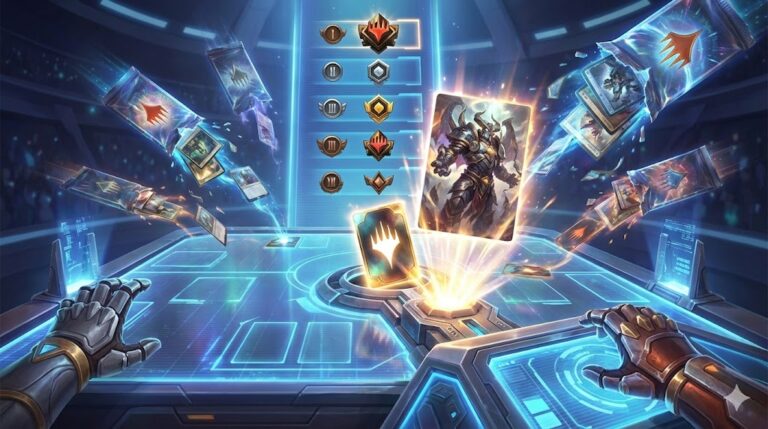
MTG pioneered the collectible card game business model, with cards of varying rarity (common, uncommon, rare, mythic rare). This model created both an economy around the game and affected gameplay, as rarer cards often have more powerful effects.
This approach has been widely adopted across gaming. Digital card games like Hearthstone and physical games like Pokémon TCG directly implement MTG’s rarity systems. Video games have embraced this through loot box mechanics and rare item drops. MMORPGs feature equipment with rarity tiers that directly mirror MTG’s system.
Mobile gaming has perhaps most enthusiastically adopted this concept. Gacha games prominently feature rarity-based character systems where higher-value characters appear less frequently. The psychological impact of obtaining rare combinations mimics the satisfaction of playing a mythic rare card in MTG. Social games with collectible elements have further blurred the line between gaming platforms, incorporating MTG-inspired collection mechanics to enhance player engagement.
The Limited Format Philosophy
MTG introduced several “limited” formats, such as Draft and Sealed, where players create decks using only the cards they open during the event. These formats challenge different skills compared to constructed formats and ensure a fair playing field, regardless of a player’s card collection.
This limited format approach has influenced numerous games. Digital card games routinely offer draft modes directly inspired by MTG. Board games like Dominion, where players build their deck during gameplay from a common pool of cards, show clear influence from MTG’s limited formats.
Many competitive video games have adopted tournament structures that mirror MTG’s approach to limited play. Battle royale games where all players start with minimal equipment create a similar “level playing field” environment to MTG drafts, where success depends on skill rather than pre-game advantages.
The Concept of “The Stack”
MTG’s sophisticated timing system, known as “the stack,” allows players to respond to each other’s actions in a last-in, first-out sequence. This creates intricate interaction possibilities and rewards careful timing of abilities.
This concept has influenced numerous digital card games, which incorporate their own versions of response windows and ability timing. Video games like League of Legends feature ability queuing systems reminiscent of MTG’s stack. Even fighting games implement frame-specific counter windows that create similar strategic depth around action timing.
Digital board games have begun implementing more complex action sequences with timing elements. Modern adaptations of traditional games sometimes include special abilities or features that can be activated in response to certain game states, creating a simplified version of MTG’s stack-based interactions.
Multiverse Storytelling
MTG pioneered the concept of telling an ongoing narrative through card sets, with each expansion exploring new worlds within a connected multiverse. This approach to storytelling through game mechanics has influenced numerous other games.
Video game franchises like Final Fantasy and The Elder Scrolls adopt similar approaches to worldbuilding across connected but distinct settings. Other card games frequently release themed expansions that build upon established narrative universes.
Even tabletop role-playing games have adopted this storytelling approach, with connected campaign settings that feature progressive narratives across multiple sourcebooks. Players encounter recurring characters and advancing storylines as they move between related games, mirroring MTG’s plane-hopping narrative structure.