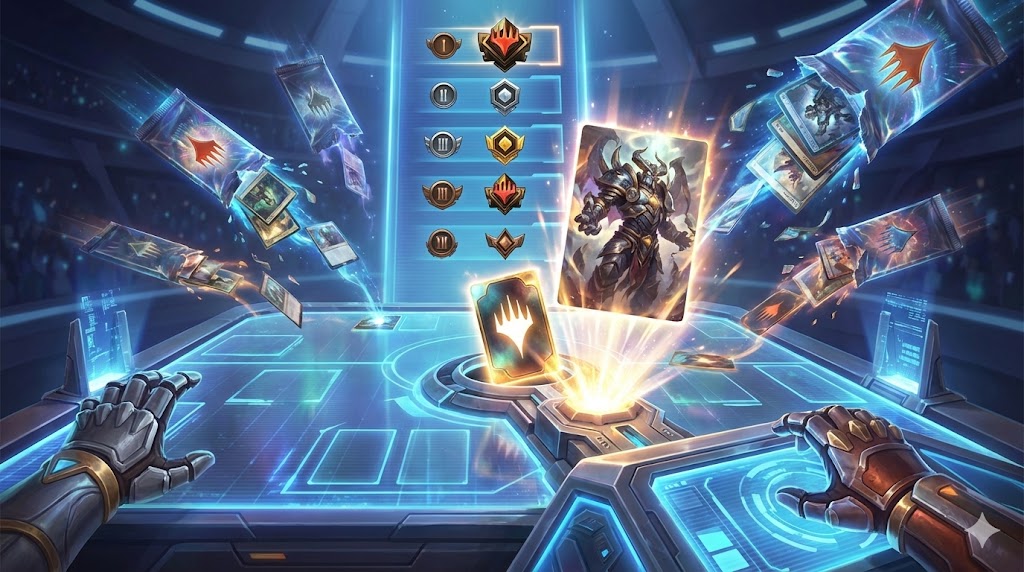

The advances of automation have largely improved the gameplay, removing much of the technical friction that once made Magic harder to pick up. As a result, new players can reach ranked matches quickly.
But what the game doesn’t make any simpler is staying relevant when the ranked ladder is full of optimized decks, new sets, and changing strategies. Progress heavily depends on much more than just play skill — you have to make deliberate choices around decks, formats, resources, and time.
In this article, we’ll break down what it really takes to keep up at higher ranks.
What’s MTG Arena?
Arena is played in exactly the same way as the tabletop version of the game. If you’ve ever seen any other CCG, you already have a general idea of what it looks like. Two players try to defeat each other by playing cards: creatures, artifacts, spells, and so on. MTG mechanics are quite complex for beginners (for example, there is not one type of mana, but five), but don’t worry: when you first start the game, it will guide you through a tutorial in the form of a short adventure. The tutorial helps beginners learn the basics and allows experienced players to adapt to the digital format.
The Wizards of the Coast project skillfully simplifies some of the tedious aspects of physical MTG and allows you to focus on strategy rather than meticulously following all the minor rules. The turn is conveniently divided into phases, and the game will always tell you when and what you can play. In the tabletop version, only experienced players who knew the synergies of over a thousand cards by heart could build decks, but the digital version sorts and organizes cards according to various parameters.
There are several game modes in Arena: regular constructed play and Draft, where players build a forty-card deck by selecting cards from boosters. The sealed deck format, or sealed, has also been transferred to the digital version. This format allows you to get acquainted with new cards and play in a tournament by assembling a deck from six available boosters.
If you’ve never played the tabletop version and decided to try Arena after playing Hearthstone, you’ll have to get used to some nuances. For example, mana doesn’t come by itself, but is obtained from lands played from your hand — these are a special type of card. You can only play one per round. And each card, whether it’s a creature or a spell, requires a certain amount of mana of the corresponding color.
For winning, you receive level points that can be invested in the progression track. It’s like leveling up in an RPG, only instead of abilities, you get unique cards.
You’ll have to figure out many of these subtleties on your own, through trial and error.
So don’t rush, it’s better to first get to grips with the starting decks and understand how everything works. Poor card management is the main source of problems in a duel with a human opponent.
Understanding these fundamentals is essential before moving on to deck building and long-term progression.
Why Wildcards Matter
Since most rewards are random in this game, wildcards become the main limiting factor. With their help, you can craft exactly what a deck needs, but they’re so rare that mistakes stick around, being hard to undo. Higher-rank players wait until it’s clear which decks are actually strong, avoid using narrow cards too early, and treat each of them as a strategic decision, not a shortcut.
In fact, building a deck is not that complicated, but maintaining one through new sets, rotations, and balance changes is what differentiates accidental success from consistent performance.
Because wildcards are limited, experienced players tend to:
- Avoid using niche or “fun-only” cards early
- Focus on staples that appear across multiple decks
- Delay crafting until the meta stabilizes after a new set release
The Format Trap Most Players Ignore
Just like tabletop Magic, formats define everything in MTG Arena. It may be one of the following:
- Standard
- Alchemy
- Historic
- Explorer
Each of them has its own card pool, power level, and pace of change. Consequently, players’ long-term ladder viability depends heavily on where exactly they choose to play.
Standard is often viewed as the “entry point” for competition, but it also rotates quite often, so the cards you craft today may become useless in a year. At the same time, both Historic and Explorer formats offer longer-lasting value. Alchemy adds more instability due to digital-only rebalances, changing which decks are strong overnight.
Experienced players don’t just pick a format; they commit to understanding its rhythm. They take their time to monitor trends, follow popular archetypes, and test playing against expected matchups instead of random opponents.
How New Sets Reshape Play
When a new set is dropped, it inevitably brings excitement to the community of gamers. Still, there is also pressure, including spoilers and irrelevant deck ideas. In order to keep up, players should refine decks regularly. It doesn’t mean you have to craft a new list; just do some upgrades, such as better mana bases, improved sideboards, or swapping weak cards.
This is where both time and money overlap. Grinding daily wins, completing daily quests, as well as drafting efficiently can cover some costs, but not all. After accounting for possible expenses, like purchasing additional gems, some players may explore external financial tools to better handle competitive play expenses without disrupting their broader budgets.
The point isn’t that spending is a must — it’s that competitive play has real economic considerations, even in a digital setting.
Why Preparation Takes Time
In MTG Arena, most matches are effectively decided before the actual opening hand is drawn. Don’t get that wrong, it’s not because the results are predefined by the system, but because seasoned players always prepare for most scenarios. Indeed, it’s all about doing homework and analyzing which decks are the most common, what strategies perform better than others, and which matchups are harder to play.
Right after a new set drops, things change really fast. Some decks rise quickly, others vanish, and early results make the difference obvious. Players who are attentive enough save their wildcards; those who don’t often end up invested in decks the game has already moved past.
Adaptation always takes time, and it is more important than most players realize. But the proper approach, paired with consistency, does pay off over time, slowly compounding into gems, mastery passes, and wildcards. Ignoring that aspect seems minor, but later on, you may see a real gap in resources and performance.
The capacity to stay viable in the MTG Arena competitive community isn’t about playing 24/7, but keeping up with the updates and trends. If you are the one combining awareness with regular, focused play, you’ll be able to keep pace each time the game evolves. If not, you may fall behind in realizing when it happens.
Drafts, Losses, and Adaptation
Many Constructed players skip Limited formats, even though drafting influences long-term competitiveness. When performed well, it helps both convert gold into cards, gems, and wildcards and sharpen core decision-making skills.
Drafts leave little room for mistakes. Early missteps become obvious soon, particularly when trying a new set. Those lessons transfer directly to ranked play. Competitive players treat losses the same way — by asking what failed and whether the problem was the matchup, the mulligan, or a recent balance change.
Patches also add constant pressure. Balance updates, specifically in Alchemy, can invalidate decks in no time. Strong results come from a perfect understanding of the situation — adjust strategy when needed, or just move on.
Burnout and Sustainable Competition
Burnout is one of the gaming aspects that is usually neglected as something not important. In fact, trying to chase every meta shift, grinding endlessly, and stressing over resources can easily take the fun out of the game. Ironically, it often leads to worse performance.
Here are some tips to help you better distribute your energy:
- Focusing on no more than two formats
- Skipping a set if it doesn’t really interest you
- Accepting that you don’t need every deck
The best competitive players aren’t just skilled — they’re disciplined enough to invest their energy properly.
So What Does It Really Take?
The ability to compete in MTG Arena isn’t defined by spending more money or owning the fanciest decks. It’s all about being reasonable and flexible under constant change, as well as managing your wildcards set carefully. Knowing when to adjust — and when to wait. Investing time consistently rather than pushing too hard.
Most importantly, it’s about recognizing that MTG Arena is a living game. The rules may stay the same, but the environment never stops changing. Players who embrace that reality, rather than fight it, are the ones who stay ahead — set after set, season after season. At the end of the day, improvement isn’t built on avoiding losses but on learning faster than the meta changes.