
Best-of-One can make MTG Arena feel personal. You keep a 2-land opener, miss land 3 twice, and then, in the next match, you draw lands until your hand is all mana and no decisions. Most “streakiness” is not a hidden switch. It is what a 60-card system looks like when you judge it from a tiny slice of games and let the mind supply the missing context.
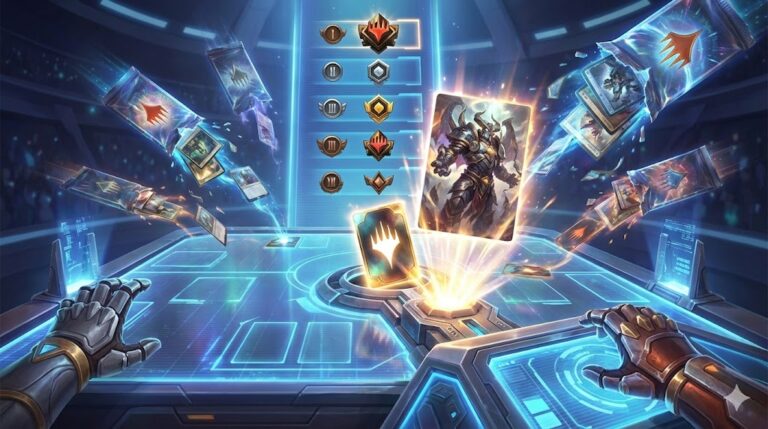
A current snapshot of the Standard ladder gives context on what the wider meta is doing when your last 10 games feel unusually swingy.
Clumping and Story-Making in Best-of-One
Random sequences clump. The quiet middle gets erased, while the spikes stay vivid. That is why you remember the non-games and forget the matches where your draws were fine and the result came down to choices. Best-of-One amplifies this because games are short, you see fewer total draws per session, and your brain keeps stitching meaning across results that were never connected.
A clean way to understand that feeling is to look at games that are totally driven by chance: spending a bit of time in this environment will help you realize that your brain seeks patterns even when they are explicitly absent. Take the world of slots, for example. Here, we all know that the outcomes are determined by a random number generator; there aren’t streaks or patterns affecting how the reels land. Despite being aware of that, if you play slots for any period, you’ll find that you still feel like patterns exist. A lucky run can start to feel like the machine is hot – while the inverse creates a cold sense.
Humans like patterns, and we look for them even when we’re playing in deliberately random environments. Getting to grips with this in the world of slots can make it easier to understand in the world of Magic: The Gathering. It won’t totally eradicate your instinct to look for patterns, but it will serve as a good reminder that luck is the main factor here. Whether it’s spinning the reels in a slot machine or hoping for the perfect next draw in an MTG game, luck is not beholden to patterns.
Randomness Does Not Look Even in Real Time
A fair shuffle often does not feel balanced from moment to moment. It produces streaks, gaps, and awkward clusters that only average out over many games. The “due” feeling is the common trap: after three lands, a spell feels due, and vice versa. But the deck has no memory. Each draw is a fresh sample of what remains, not a correction for what just happened.
So zoom the question in. Instead of “Is the shuffler rigged?” ask, “How often did my strategy require a specific card to function?” That is measurable and helps you keep the story straight.
What Best-of-One Changes and What It Cannot
Best-of-One compresses everything into a single game. You do not get sideboard games to correct for extremes, and you face a wide spread of strategies. That naturally increases the swing in how a session feels.
Opening hands are also a special case in digital play. Even if a queue uses an opener method that reduces some extreme starting hands, it cannot control what you draw on turns two through six. Most “flooded” and “stuck” games are decided there. That is why the practical levers matter more than theories: curve, mana sources, keep rules, and early interaction.
If you want a broader refresher on formats, resources, and daily play rhythms, this MTG Arena beginner guide for 2026 is a useful companion.
Variance or Misplay: A Three-Filter Reality Check
You do not need advanced statistics. You need a consistent review lens you can apply after any session, especially after a rough run.
Run each loss through three filters:
- Construction: Could your deck cast spells on turns one through three with high reliability?
- Mulligans: Was your starting hand functional, or did you choose to keep it in the hope of a specific draw on the next turn?
- Sequencing: Did you spend mana efficiently, play to your outs, and take lines that kept options open when behind?
If a filter fails repeatedly, change the numbers or habits. If all three look fine across a bigger sample, call it variance and move on.
Small Adjustments That Make Sessions Feel Less Swingy
Start with your keep rules. If your hand cannot cast multiple spells by turn three without help, it is often a mulligan even if it looks “playable.” Next, tune for early stability: more 1 and 2 mana plays, a curve that does not demand perfect draws, and mana sources that match your real casting needs.
Finally, treat streak feelings as a cue to slow down, not to queue faster. Take 30 seconds, log the facts, and decide whether you are adjusting deck numbers, mulligan thresholds, or nothing at all. Over time, Best-of-One stops feeling streaky and starts feeling readable. Streaks can feel particularly noticeable in Magic, especially after the current set cycles out, because the change of cards alters your perception of how often cards can be expected to appear. Still, by approaching the game logically, you can overcome this feeling.