

Through the Omenpaths: What Universes Within Means for Arena Players
The landscape of Magic: The Gathering Arena underwent a seismic shift in September 2025, and as we move through January 2026, players are still grappling with the implications. The introduction of Through the Omenpaths—digital-exclusive sets that reimagine Universes Beyond content within Magic’s own multiverse—has fundamentally changed how Arena handles crossover content. For competitive grinders, casual collectors, and everyone in between, understanding this new paradigm isn’t just helpful—it’s essential for navigating the game’s immediate future.
The Genesis of Through the Omenpaths
To understand where we are, we need to examine how we got here. When Wizards of the Coast announced that Universes Beyond sets would become legal in all formats starting in 2025, the company faced a significant challenge: how to bring this content to digital platforms when licensing agreements didn’t always permit it. The solution, revealed in dramatic fashion, was Through the Omenpaths—a digital initiative that would provide mechanically identical but creatively distinct versions of certain Universes Beyond sets.
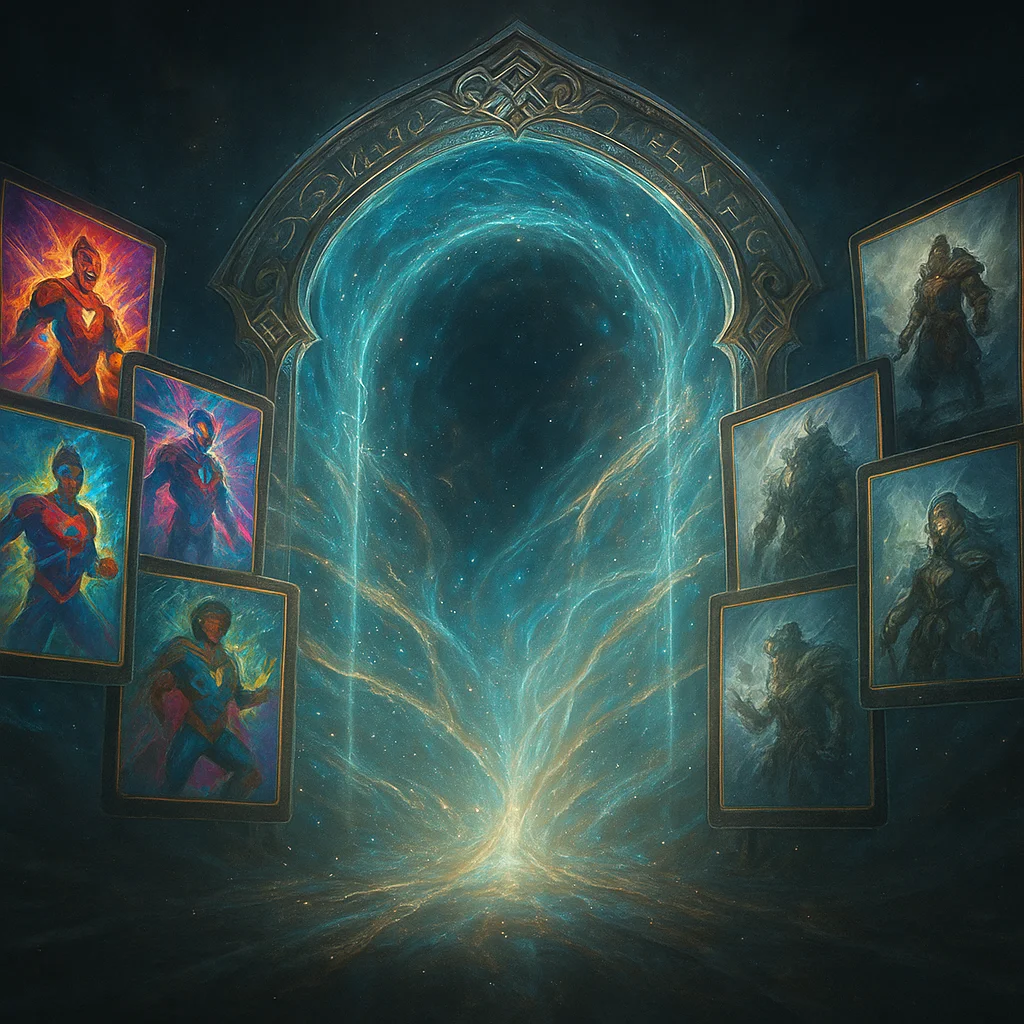
The first Through the Omenpaths set, designated OM1 (with bonus sheet OMB), launched on September 23, 2025, serving as the digital counterpart to Marvel’s Spider-Man. Rather than swinging through New York as Peter Parker, Arena players encountered entirely new characters exploring Magic’s established planes. The mechanics remained identical—Spider-Man’s signature “web-slinging” became “enweb” in OM1—but the creative treatment placed everything firmly within Magic’s narrative universe.
This wasn’t merely a cosmetic change. As Wizards explained in their announcement, Marvel sets wouldn’t be coming to digital Magic platforms at all. Instead, every Marvel release would receive the Through the Omenpaths treatment going forward. The most likely explanation, though never officially confirmed, points to licensing conflicts with Marvel SNAP, which may hold some form of digital-exclusive rights that prevented the characters from appearing in Arena unchanged.
What Makes Through the Omenpaths Different
The technical implementation of Through the Omenpaths reveals careful consideration of player experience. When players import a deck containing card names from a Universes Beyond set, Arena automatically swaps them to their Through the Omenpaths equivalents. Search for a Universes Beyond card name in the deckbuilder, and the corresponding Omenpaths version appears. Even searching by the Universes Beyond set code pulls up the Through the Omenpaths equivalent.
Mechanically, these cards are perfect mirrors. The mana cost, card types, text box, rarities, and power/toughness remain completely unchanged. Only the names and artwork differ. This ensures that competitive integrity remains intact—a deck built around specific mechanics performs identically whether you’re using the Universes Beyond version in paper or the Through the Omenpaths version digitally.
Furthermore, these cards carry full format legality across Arena’s entire ecosystem. Players can deploy Through the Omenpaths cards in Standard, Alchemy, Historic, Pioneer, Timeless, and Brawl, just as they would any other legal release. This universal legality stems from the broader policy shift that made Universes Beyond sets Standard-legal beginning in 2025—a change that marked one of the most significant format adjustments in Magic’s recent history.
The 2026 Release Calendar: A Scheduling Quirk
As we navigate January 2026, Arena players face an unusually packed schedule. This year will see seven Magic sets rather than the typical six—what Wizards describes as “a bit of a scheduling quirk” that won’t become the norm. Starting in 2027, the company plans to return to a six-set annual cadence.
The calendar kicked off with Lorwyn Eclipsed on January 23, 2026, an in-universe set that brought players back to one of Magic’s most beloved planes. Next up, Magic: The Gathering | Teenage Mutant Ninja Turtles releases worldwide on March 6, 2026. Notably, Arena players get early access on March 3—three days before the paper release, giving digital grinders a head start on deck development and testing.
Following TMNT, Secrets of Strixhaven arrives in April 2026 as another in-universe release. Then comes the big one: Marvel Super Heroes on June 26, 2026. This set will use a Through the Omenpaths treatment for its digital release on Arena and MTGO, maintaining consistency with the policy established by the Spider-Man set.
The second half of 2026 brings three more releases. Magic: The Gathering | The Hobbit arrives in August 2026 on both tabletop and Arena—importantly, this set will come to Arena with its original names and artwork intact, showing that not all Universes Beyond content requires the Omenpaths treatment. Reality Fracture follows in October as an in-universe set. Finally, Magic: The Gathering | Star Trek will make its voyage to both tabletop and Arena in November 2026, again with original creative intact.
Which Sets Get the Treatment?
The selective application of Through the Omenpaths reveals a practical rather than philosophical approach. As Wizards clarified, they’re not creating Through the Omenpaths versions for every Universes Beyond set—only those that won’t be coming to digital platforms in their original form.
Currently, this policy explicitly affects future Marvel sets, which will all receive the Omenpaths treatment. Meanwhile, other major crossovers like FINAL FANTASY, Avatar: The Last Airbender, The Hobbit, and Star Trek will all come to Arena and Magic Online with their original names and artwork preserved. The determining factor appears to be licensing agreements on a case-by-case basis rather than a blanket policy against crossover content on digital platforms.
Additionally, Wizards specified they’re only creating Through the Omenpaths releases for full sets legal in all formats. This suggests smaller releases or supplemental products might follow different rules, though specifics remain to be announced.
The Standard Rotation Shake-Up
The introduction of Universes Beyond to Standard necessitated substantial changes to rotation schedules. Most significantly, there will be no rotation in 2026. Instead, Wizards is using this year to prepare for a restructured rotation system that begins in 2027.
Under the new model, Standard rotation moves to coincide with the first set of each calendar year. When 2027’s first release arrives, Standard will encompass sets from 2025, 2026, and 2027—maintaining the three-year window while creating a more intuitive rotation schedule tied to the calendar year rather than the fall release that traditionally marked rotation.
This change reflects Wizards’ attempt to balance multiple priorities: incorporating Universes Beyond content into Standard, maintaining format health, and reducing the “churn” in larger non-rotating formats. As the company explained in their policy announcements, Universes Beyond sets would now go through the typical lifecycle of booster sets, with Limited play at release and contributions to each Constructed format appropriate to the format’s size. Standard power-level heuristics and Future Future League testing would be applied to maintain competitive balance.
Innovation in Limited: Pick-Two Draft
Beyond constructed play, Through the Omenpaths introduced a significant innovation for Arena’s Limited environment. OM1 became the first Standard-legal expansion specifically designed for a different drafting method: the new Pick-Two format.
Rather than traditional eight-player pods making single picks, Pick-Two utilizes four-player pods where players make two picks per pack throughout the draft. This format debuts across multiple queues: Traditional Draft, Pick-Two Draft, and Quick Draft all implement the two-picks-per-pack system. Pick-Two Draft and Quick Draft offer ranked play, while the format itself is built to offer a faster alternative at reduced cost for players short on time.
The smaller set size of OM1 made it particularly well-suited for this experimental format. Early reception suggests players appreciate the faster pace, though competitive Limited specialists continue debating whether Pick-Two creates the same depth of strategic decision-making as traditional draft formats.
Community Response: Divided but Engaged
The player reaction to Through the Omenpaths has been notably complex. According to community discussions and feedback aggregated since the September 2025 launch, the response was overwhelmingly positive—but for varied and sometimes contradictory reasons.
One significant constituency comprises what might be called Universes Beyond skeptics—players who prefer Magic’s original creative universe but still want access to mechanically interesting cards. For these players, Through the Omenpaths provided a welcome alternative. As one community sentiment expressed it: “Many people liked the alternate digital version of Spider-Man way more than the intended Universes Beyond version.” The Omenpaths treatment gave designers opportunities to check in on a bunch of different planes that already exist in the Magic universe, satisfying players who want to avoid casting Eddie Brock or Gwen Stacy.
However, enthusiasm hasn’t been universal. The most significant concern centers on cognitive load for players competing across both paper and digital formats. Standard grinders who practice extensively on Arena develop mental associations with specific card names and artwork. When transitioning to paper tournaments, they must mentally swap these associations to the Universes Beyond versions. As critics note, “this decision could lead to confusion, especially for players jamming decks across both paper and digital formats.”
The memorization challenge extends beyond competitive players. Casual deck builders face the task of searching to find the matching in-universe version when assembling Arena decks from paper lists, or vice versa. While Arena’s auto-swap functionality helps, it doesn’t eliminate the fundamental issue: players now must maintain mental databases of card equivalencies that exist purely due to licensing restrictions.
Nevertheless, community analysis suggests these concerns haven’t significantly dampened engagement. Through the Omenpaths has already made an impact, with numerous cards finding homes in established decks and inspiring new brews across multiple formats.
The Lore Connection: Omenpaths in Magic’s Story
Beyond the mechanical and logistical considerations, Through the Omenpaths draws its name and thematic foundation from recent Magic lore. In the aftermath of March of the Machines, portals between worlds called “omenpaths” opened throughout the multiverse. Originating on Kaldheim, these omenpaths spread to many planes during the Phyrexian invasion via the corrupted World Tree.
The “Omenpath Arc,” beginning with Wilds of Eldraine, represents the first part of a three-year story arc following the conclusion of the Phyrexian storyline. These narrative omenpaths open possibilities for characters who have never interacted to meet each other, and planes that previously had no connection to experience crossover moments.
The naming choice proves thematically appropriate. Just as omenpaths in the lore connect disparate planes and enable unprecedented crossovers, Through the Omenpaths as a product initiative bridges the gap between external universes (Marvel, in particular) and Magic’s own multiverse. The creative treatment literally transplants Universes Beyond mechanics into Magic’s planes, using omenpath-style connections as implicit justification.
Financial Implications and Collection Management
The dual existence of paper Universes Beyond and digital Through the Omenpaths versions creates unique considerations for collection management and card values. While Arena’s digital economy operates independently from paper prices, the bifurcation raises questions about long-term reprinting strategies.
Wizards has confirmed that individual Through the Omenpaths cards may be reprinted in paper, suggesting these won’t remain digital-exclusive indefinitely. This policy could eventually provide alternatives for players who prefer the in-universe creative treatments, potentially affecting the collectibility of original Universes Beyond printings.
From a business perspective, the arrangement appears driven primarily by licensing economics. As observers noted, Hasbro either didn’t want to pay for digital licensing or Marvel refused digital usage rights. The solution creates extra work for digital deck brewers but allows Wizards to capture the mechanical designs regardless of licensing limitations. The impact falls primarily on digital players, with little to no effect on paper pros who never interact with the Through the Omenpaths versions.
Looking Forward: The Path Ahead
As we progress through 2026, Arena players can expect the Through the Omenpaths framework to become increasingly normalized. The Marvel Super Heroes set in June will provide the second major test of the system, revealing whether Wizards has refined the implementation based on OM1 feedback.
The selective application to Marvel content while other Universes Beyond properties come to Arena unchanged suggests a pragmatic, partnership-by-partnership approach rather than ideological opposition to crossover content on digital platforms. This flexibility likely serves Wizards well as they negotiate future Universes Beyond collaborations.
For competitive players, the key adaptation involves maintaining mental flexibility across platforms. Standard grinders must develop strategies for memorizing card equivalencies, whether through deliberate study sessions or simply through repetition as they play. The auto-swap functionality helps, but cannot entirely eliminate the cognitive overhead.
Meanwhile, the broader integration of Universes Beyond into Standard and the rotation schedule changes mean Arena’s metagame will increasingly reflect a hybrid identity—part traditional Magic planes, part external IP, with Through the Omenpaths serving as the translation layer where necessary. Whether this hybrid approach strengthens or dilutes Magic’s identity remains a question that will only be answered through years of accumulated player experience.
Conclusion: Navigating the New Normal
Through the Omenpaths represents a creative solution to a complex problem, even if that solution introduces its own complications. For Arena players, the essential takeaway is straightforward: mechanically identical cards with different creative treatments will become a regular feature of the digital experience, particularly for Marvel content.
The system works, even if imperfectly. Players have adapted, the cards are seeing play across formats, and the competitive integrity remains intact. As the 2026 release schedule unfolds with its unusual seven-set structure and mix of in-universe and crossover content, Arena grinders have the tools they need to succeed—they just need to remember that Spider-Man and his enweb counterpart are one and the same, separated only by an omenpath’s width.
