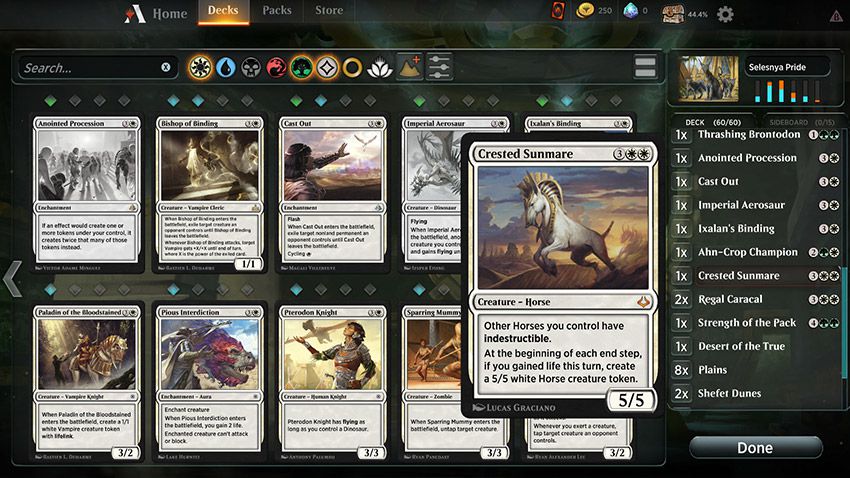

Arena has that same addictive vibe as a good game of Civilization. Not only does it evoke the tactile nature of the original card game, it tastefully enhances the experience and dramatically speeds up play. Overall, this game shows incredible promise. Magic: The Gathering Arena is not a dumbed-down version of the legendary CCG. This is 100 percent genuine Magic, with card sets that parallel the current tournament-legal blocks of cards available at your friendly local game shop. When the game is complete you’ll need to buy the majority of your cards from blind packs in order to build up your collection. But, unlike the physical card game, the plan is for booster packs to also come with so-called wild cards that will allow you to exchange them in order to add a specific card to your collection.
Obviously Magic: The Gathering Arena is a completely different play experience than can be found in the bevy of simpler digital CCGs that have become popular in recent years. But Wizards of the Coast’s internal development team has clearly taken inspiration from games like Gwent and The Elder Scrolls: Legends. Their playfields are stylish, but not over-the-top, sort of like what would happen if Hearthstone put on a suit and tie and got a day job.
Likewise, the ambient soundscape is additive, with a tinkling of sound here and there. Dinosaurs growl and pirates fire pistols when they come into play, but there’s nothing distracting about it.
The nicest feature by far is the phase indicator at the bottom of the screen. There are multiple parts to each player’s turn in Magic, and those phases are the rails on which the entire game system runs. Certain cards can only be used during a certain phase, certain cards break certain phase rules, that sort of thing. The user interface clearly shows you which phase you’re in at any given moment, and highlights the cards in your hand and on the table that are eligible to be played at any given moment.
By default the phase indicator just lets you move cards around as you will, skipping certain portions of each turn in an effort to speed up play.
Alternately, you can toggle a “stop” on certain phases in your turn, which will act as a brake so that you don’t go too fast and miss a step. It’s particularly handy if you’ve got a strategy up your sleeve that requires multiple cards to be played over multiple phases of your turn, or if you’re a less experienced player like I am. But by default the game trusts you to know what you’re doing and won’t slow you down unless you ask it to.
The entire system is fluid, intelligent and a lot of fun. It respects the player’s intelligence while also respecting the source material itself with high-quality art and appropriate animations.