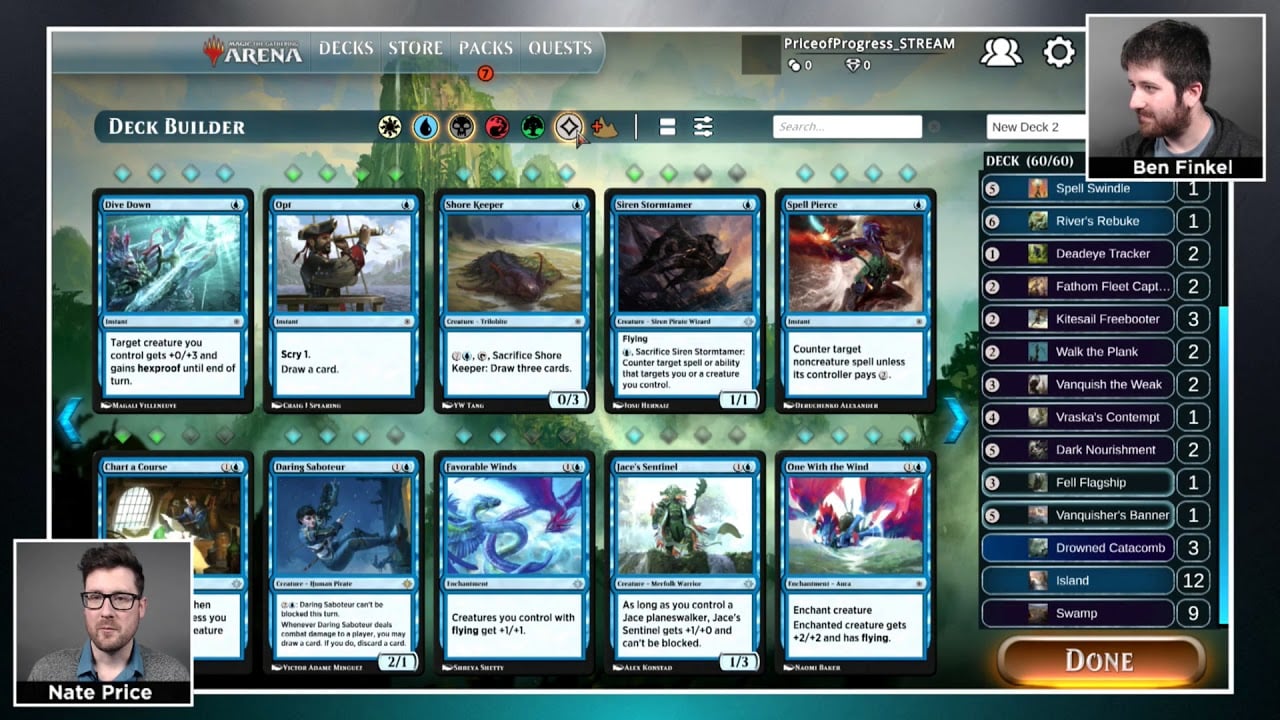

“Arena” is planned to be a free-to-play game with no attached fees or required purchases. As of right now in the beta, it offers two in-game currencies. Gold can be earned by playing the game, via winning matches, competing in events, and completing quests. Gems (not yet implemented as of this writing) are only available if you buy them with real money via the in-game store.
- Both gold and gems can be used to unlock cards and special events in-game, and the only items that must be purchased with gems are planned to be strictly cosmetic unlocks. (No one’s said what those cosmetic unlocks will be as of yet. There’s a rumor, based on past “Magic” games, that it might include the ability to use older or different art on your in-game cards than what’s conventionally available.)
- You can use gems to unlock normal cards and other such purchases, so you can throw money at “Arena” in order to hit the ground running. Much like other, similar game economies, what you’re really using your money for in “Arena” is the ability to surmount whatever initial treadmills would typically confront the new player. If you’ve got time, but not money, you can play for free; if you have money, but not time, you can drop money on a few extra pulls of the slot machine lever. Both players end up in the same place eventually, but the latter gets there measurably faster.
- You earn cards in “Arena” by winning matches, at a rate of up to 30 per day. You can also buy eight cards at once in booster packs and 14 cards at once via draft packs. You may also find “wildcards” in your packs which can be redeemed for a card of your choice of a matching rarity.
Finally, every time you open a booster or get a fifth duplicate of a card you already own, you earn progress toward opening the Vault. What this means is still being worked on, but Clay makes it clear that one of the guiding ideas behind “Arena” is to “make sure players get the specific cards they want.” There’s a lot of random chance involved in the card acquisition process, but between wildcards and the Vault, the system is designed to have its own blind-luck protection built in. Every time you open a random selection of cards and get one you don’t want, you’re ostensibly earning progress toward the ability to select a card you do want.