
MTG Arena Beginner’s Guide: Everything New Players Need to Know in 2026
Starting your journey in Magic: The Gathering Arena can feel overwhelming. With multiple game formats, complex economy systems, and thousands of cards to learn, new players often wonder where to begin. Fortunately, MTG Arena has evolved into one of the most accessible digital card games available, offering a robust free-to-play experience across multiple platforms. This guide breaks down everything you need to know to start your Arena adventure in 2026.
Getting Started: Your First Steps in Arena
MTG Arena is completely free to download and available on PC, Mac, Android, and iOS devices. The mobile versions launched back in March 2021, making it easier than ever to play authentic Magic gameplay wherever you are. What makes Arena particularly appealing is that purchases are not required to access the full depth of the game. While some players worry about pay-to-win mechanics, Arena operates on a “pay to get on even terms faster” model. A dedicated daily player can expect to build a competitive deck within a month or two without spending any money.
When you first launch Arena, the tutorial system greets you with a comprehensive introduction to Magic’s fundamental concepts. These tutorials cover essential mechanics like playing lands, casting spells, attacking, and blocking. The best part? You can skip the tutorial at any point and still receive all the associated rewards without playing through every single game. This flexibility respects both newcomers who need guidance and returning players who already know the basics.
The Color Challenge: Building Your Foundation
Following the tutorial, the Color Challenge introduces you to each of Magic’s five colors of mana. This structured experience teaches you how white, blue, black, red, and green approach the game differently. More importantly, you’re rewarded with the actual decks used during these challenges. By the time you complete the Color Challenge, you’ll have accumulated a solid foundation of starter decks to begin your collection.
MTG Arena provides players with dozens of starter decks overall, including options for each single color and various two-color combinations. These aren’t throwaway decks either. After completing the tutorial, you’ll unlock the Starter Deck Duel event. This clever system lets you pick any of ten preconstructed decks, and once you win a game with it, that deck gets added to your collection permanently. Notably, these starter decks feature Alchemy cards that don’t rotate out of legality, giving them longevity beyond typical Standard rotations.
Jump In! Your First Real Event
Once you’ve completed the fourth Color Challenge tutorial level, Arena grants you five free Jump In! tokens as a one-time reward. Jump In! is specifically designed as an event for new players, allowing efficient card collection while learning deck construction principles. The event costs just 1,000 gold or 200 gems, making it remarkably affordable.
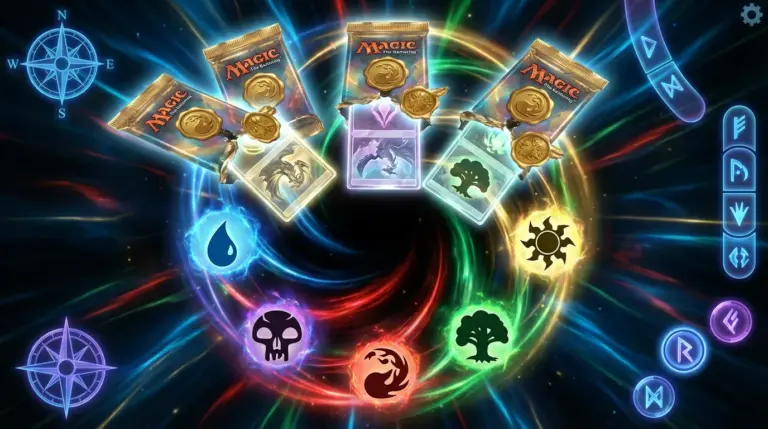
The Jump In! format works elegantly. You choose two themed packets custom-made for MTG Arena, each containing cards from sets currently legal in Alchemy and Standard. These packets combine to create a ready-to-play 40-card deck. This system proves particularly valuable for targeting specific rares and mythic rares you want to add to your collection. Your first win in Jump In! awards an uncommon individual card reward with a 5% chance to upgrade to a rare or mythic rare, adding an exciting element of potential bonus value.
Understanding Arena’s Game Formats
Choosing the right format significantly impacts your Arena experience. As a beginner, understanding the differences between formats helps you invest your resources wisely.
Standard: The Best Starting Point
Standard is the dynamic format where you build decks using cards from recently released Magic sets. As of January 2026, thirteen sets are legal in Standard, providing substantial deck-building options without overwhelming new players with Arena’s entire card pool. Here’s crucial information for planning your collection: there is no rotation in 2026. The next Standard rotation happens on January 23, 2027, when Duskmourn and all prior sets rotate out. This means any Standard cards you collect now will remain legal for over a year, making it a smart time to invest in the format.
The latest set, Lorwyn Eclipsed, arrives on MTG Arena on January 20, 2026. An early-access event took place on January 14, featuring Magic streamers and competitive players exploring the new cards on YouTube and Twitch starting at 10 a.m. PT. This gives you a chance to see high-level players evaluate cards before you start crafting them with your precious wildcards.
Alternative Formats Worth Knowing
Beyond Standard, Arena offers several other constructed formats. Alchemy is a digital-first play mode featuring cards designed specifically for the digital game, with regular balance changes to keep the format fresh. Historic allows you to use cards that have rotated out of Standard, making it perfect for players who want their collections to maintain value long-term. Finally, Timeless represents MTG Arena’s largest constructed format where every card is legal, though it’s generally recommended for veteran players with established collections.
For beginners, focusing on Standard provides the clearest path forward. The format offers competitive depth while maintaining manageable collection requirements.
Mastering Arena’s Economy: Gold, Gems, and Wildcards
Understanding Arena’s economy separates successful free-to-play players from those who struggle to build decks. The reward systems are generous if you know how to maximize them.
Daily and Weekly Rewards
Every day, players can earn gold or individual card rewards (ICRs) for up to fifteen wins. These Daily Win Bonuses reset 24 hours after each match, specifically at 3 a.m. PST on Arena’s servers. The reward structure is front-loaded to respect your time. Your first win each day grants 250 gold plus 25 Mastery XP. Wins two through four each provide 100 gold plus 25 Mastery XP. After the fifth win, rewards alternate between uncommon cards and smaller gold amounts.
Additionally, every 24 hours you receive a Daily Quest worth either 500 or 750 gold. These quests typically require winning games with specific color combinations or casting certain types of spells. Smart players reroll their 500 gold quests once per day, hoping to upgrade them to 750 gold versions. This simple habit adds up to thousands of extra gold over time.
Weekly rewards complement the daily system. Every week, you can earn 250 experience points for your first fifteen wins in Standard Play, ranked modes, or events. This counter resets each Sunday at 9 a.m. UTC. If you’re focused on maximizing value from the Mastery Pass, community wisdom suggests aiming for four wins per day as the optimal return on time invested.
The Wildcard System: Your Crafting Currency
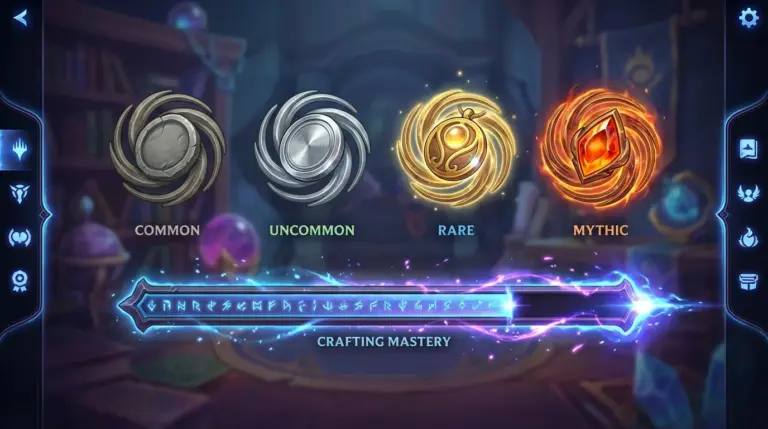
Wildcards represent Arena’s crafting system and function as the most valuable resource for building specific decks. These digital objects can be traded for any available card of the same rarity. Have a rare wildcard? You can exchange it for any rare card in Arena’s collection. This system provides targeting precision that random pack opening cannot match.
The drop rates matter for planning your collection strategy. Rare wildcards are expected to drop once every thirty packs opened. Additionally, Arena features a Wildcard Track that progresses as you open packs. The smaller track awards uncommon wildcards, while the larger track alternates between rare and mythic wildcards in a pattern: four rares, then one mythic, repeating indefinitely.
There’s also a Vault system that opens once you’ve accumulated enough duplicate cards. When opened, the Vault grants three uncommon wildcards, two rare wildcards, and one mythic wildcard. While the Vault fills slowly, it ensures that even duplicate cards eventually provide value.
Critical Advice: Conserve Your Rare Wildcards
The Arena community consistently emphasizes one crucial principle: be extremely careful with rare and mythic rare wildcards. These resources are significantly harder to acquire than commons and uncommons. New players often make the mistake of crafting every interesting-looking card they encounter. Resist this temptation.
Instead, save your wildcards for specific deck plans. Research competitive decklists, identify which cards appear across multiple archetypes, and prioritize crafting those versatile options first. The MTG Arena economy fundamentally revolves around rare and mythic rare acquisition. Your ability to build any deck you want will be limited primarily by your rare wildcard count.
Drafting: Building Your Collection Efficiently
Limited formats, particularly drafts, offer alternative pathways to building your collection while honing fundamental Magic skills. Quick Draft stands out as especially valuable for free-to-play players and those learning the game.
Quick Drafts cost 5,000 gold to join, making them accessible through daily rewards alone. Unlike Premier or Traditional drafts, Quick Draft uses AI opponents rather than other players, eliminating pick timers and wait times. This creates a more relaxed learning environment where you can take time evaluating cards without pressure.
The value proposition for Quick Draft is compelling. By spending 5,000 gold, you’re guaranteed at least three rare cards during the draft portion. Players average about four to five rares if they actively draft them instead of always picking the most powerful card. Even if you lose all your matches, you receive at least one pack and 50 gems as a reward. Winning games increases your rewards substantially, up to a maximum of 950 gems and two packs for going 7-0.
Quick Draft serves a dual purpose. You’re building your collection with cards you actually drafted while simultaneously learning card evaluation and limited gameplay skills. These skills translate directly to understanding card advantage, tempo, and resource management in constructed formats.
The Set Mastery System: Long-Term Progression
The Set Mastery system provides structured progression rewards as you play. Introduced with Core Set 2020, this system has become a cornerstone of Arena’s reward economy. A new Set Mastery becomes available whenever a new set releases on Arena, remaining active until the next set arrives.
All players gain access to the basic Set Mastery track for free, earning rewards like booster packs and five Set Mastery Orbs as they level up. You gain experience by completing daily wins and quests, with each level requiring 1,000 XP. The free track alone provides substantial value for consistent players.
The premium Mastery Pass costs 3,400 gems per season and dramatically expands your rewards. Over the course of reaching level 100, the Mastery Pass provides 2,000 gems, 10,000 gold, 20 card styles, 20 booster packs, 14 mythic cards, and 25 mastery orbs. Essentially, you’re getting back most of the gem cost while gaining significant additional value in cards and cosmetics. For players who know they’ll play consistently throughout a set’s lifespan, the Mastery Pass represents excellent value.
Free MTG Arena Codes: Don’t Miss These
As of January 2026, only two free MTG Arena codes remain valid for use, each providing three booster packs. While this might seem limited compared to other games, there’s a reason for the scarcity. Wizards of the Coast introduced a player inbox system in December 2022, allowing them to send rewards directly to players. Throughout 2023 and 2024, Wizards stopped releasing traditional codes for new sets, instead delivering boosters, cosmetics, and XP gifts as “Rewards” through the inbox system.
This change means you should regularly check your Arena inbox for free rewards rather than searching for codes online. The inbox system ensures all players receive promotional rewards automatically without needing to hunt down and redeem codes manually.
Competitive Play and Ranked Seasons
Once you’ve built a competitive deck, ranked play offers structured competition with meaningful rewards. The January 2026 ranked season began on December 31, 2025, at 12:05 p.m. PT and runs through January 31, 2026, at 12:00 p.m. PT. Ranked seasons follow a ladder system from Bronze through Mythic ranks, with players climbing by winning matches.
The top 250 Mythic-ranked players in either Constructed or Limited at the end of each season become eligible to compete in the following month’s Qualifier Weekend. These events feed into larger competitive structures, including Arena Championships. Arena Championship 11 is scheduled for February 21-22, 2026, showcasing the highest level of Arena competition.
January’s Best-of-Three Play-In event started on January 9, followed by the Qualifier Weekend on January 10-11. Notably, the format for January’s Qualifier events is Pioneer, demonstrating how Arena’s competitive scene encompasses formats beyond just Standard. While reaching the top 250 Mythic rank requires significant skill and time investment, the ranked ladder provides satisfying progression for players at all levels.
Building Your First Competitive Deck
After completing the new player experience and accumulating some resources, you’ll want to transition from starter decks to competitive constructed lists. This transition requires strategic planning to avoid wasting wildcards.
Start by researching current metagame information. Websites dedicated to MTG Arena track deck performance, popularity, and win rates across ranked play. Identify archetypes that interest you while also performing well competitively. Consider whether you prefer aggressive strategies that win quickly, controlling decks that dominate the late game, or midrange approaches that adapt to different matchups.
Look for deck overlap in your chosen colors. If you’re interested in multiple red-based aggressive decks, crafting the red staple cards first allows you to build several decks from the same wildcard investment. Similarly, rare lands that produce multiple colors of mana see play across numerous archetypes, making them safe crafts that enable deck diversity.
Avoid the temptation to build multiple tier-one decks simultaneously. Focus your resources on completing one competitive deck first. Once you have a deck capable of winning consistently, you can use it to grind daily wins and accumulate resources toward your next deck. This focused approach gets you into competitive play faster than spreading wildcards across multiple incomplete decks.
Looking Forward: What’s Next in Your Arena Journey
The beauty of MTG Arena lies in its accommodation of different play styles and goals. Some players enjoy climbing the ranked ladder competitively. Others prefer the variety of limited formats. Still others focus on collecting every card and brewing creative decks. Arena supports all these approaches.
As you gain experience, you’ll discover which aspects of the game resonate most with you. Maybe you’ll become a draft specialist, consistently going infinite by using gem winnings to enter new drafts. Perhaps you’ll focus on one or two Standard decks, mastering their intricacies to reach Mythic rank. Or you might embrace Historic or Timeless, building toward eternal format decks that never rotate.
Whatever path you choose, the foundation remains the same. Complete your daily wins and quests consistently. Be strategic with wildcard expenditures. Learn from losses rather than getting frustrated by them. Engage with the community through streams, articles, and discussion forums to accelerate your learning.
MTG Arena in 2026 offers an incredibly robust platform for experiencing Magic: The Gathering digitally. The game respects free-to-play players while providing value for those who choose to spend. With no Standard rotation until January 2027, this is an ideal time to dive in and start building your collection. Welcome to the Arena. Your first steps might feel tentative, but with patience and smart resource management, you’ll soon be competing with the best.