
MTG and Poker: Playing Professionally
Card games have been popular for centuries, and while poker has been around a long time there are newer games to try such as Magic the Gathering. But what are the differences and similarities between these two games?
MTG and Poker
Magic the Gathering (MTG) and poker are both card games with large player bases, and these days it’s possible to be a professional player at either. However, there are also very different rule sets and opportunities, and whether you prefer one or the other (either professionally or just for fun) may depend on how well it fits in with your particular playstyle and mindset. In this article, we’ll explore some of the tips and tricks to get ahead and consider online versus real-world play.
Is a real live game or online better? Well, online poker is certainly more accessible and many poker pros prefer playing at the online casinos with popular payout options because they pay faster. Of course, some people like interacting in person or are just not so keen to play online, but both options are perfectly valid for poker and MTG.
On a basic level, poker has a wide variety of rule sets but these tend to be unchanging, with minor differences sometimes (having jokers as wild cards, for example). Largely, the rules and deck remain unchanged. MTG operates in a fundamentally different way as deck composition is a key part of playing and winning. Likewise, new cards are released on a regular basis.
Both poker and MTG can be played either in person or online via not only desktops but smartphones and tablets through apps available for Android and iOS devices. This makes both very convenient, whether you’re aiming to build a career or just trying to have some fun and maybe make a little money.
MTG – Building a Deck and Starting Out
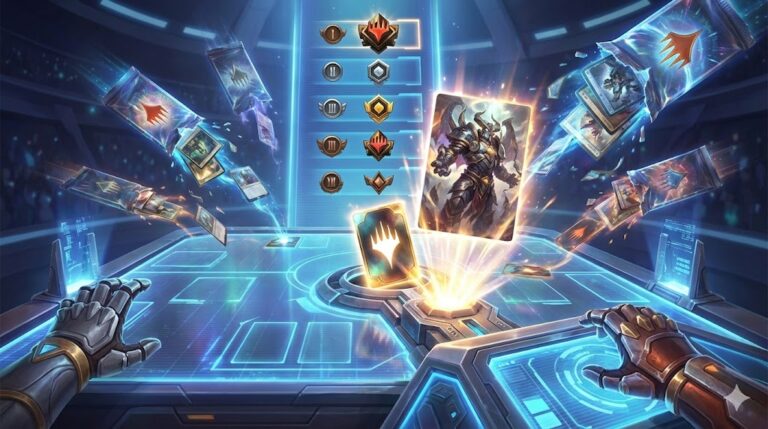
When starting out, completely unlocking the free starter decks can be a good way of working out what your own playstyle is, whether that leans more towards being a control player or more aggressive (or something in between). And be sure to take advantage of the many free codes to get multiple packs and expand your decks.
Playing standard events to get comfortable with the rules, and to help build up your own deck, is a good idea. Just as Usain Bolt didn’t step onto the track and immediately beat the world, it takes a little time to get into the groove and work out what’s what. Similarly, with poker, don’t be afraid to play for dinky stakes when you’re starting out and getting to grips with the mechanics (and psychology) of the game.
Tips and Tricks
There are certain hands in MTG that you should mulligan, but these might be more numerous than assumed. It’s not just the clear cut appalling hands of just land that should be handed back, if you have a sort-of, kind-of ok hand that’s really not good enough, don’t be afraid to hand it back. Much the same applies in poker. If your hand isn’t dreadful but there have already been five or six players staying in, the odds are you’re going to get nowhere. Don’t be afraid to fold, and to fold pretty often. Even if you have something like Q10, with that many players the odds are they’ve got K and A between them.
This is more MTG-specific because there are so many more cards and various decks, but learning the ins and outs of each deck allows you to properly assess risks and know when to make your move (or not). It’ll take some time to learn (the closest casino equivalent would actually be in blackjack, learning basic perfect strategy for single-deck games) but is well worth the time investment.
Knowing when to be defensive or apply pressure is another important point. In poker, if you’re facing someone who’s been bullied into folding before then by all means up the ante and make them sweat. In MTG, if you’ve got the more dominant position then keep being aggressive. Players under stress often make more mistakes.
Bluffing and Knowing the Odds
Varying your approach is vital in both games. If you’re playing poker and never bluff then people will know how to play you. If they can’t be sure, then that doubt creates a window of opportunity to both bluff them into folding and, at other times, to make a bundle because they called you, thinking you were bluffing. Likewise, in MTG bluffing can mislead your opponent so they make errors.
One poker-specific tip is while pocket aces (or any pair) is a very nice start, it’s not a guaranteed win, so don’t get too carried away. Get pocket aces and then face two or three Ks face up in the community cards and any other player with a K in their hand is going to just love taking your money. Of course, if you had QK in that theoretical game, it’s a whole other story…
It’s estimated that 40 million people around the world play MTG and there’s never been a better time to start playing. This coincides with the rise of eSports, making it ideal for players who prefer online to get into the game.
Prize Funds
Aspiring pros have differing ambitions, whether it’s just fun plus a little cash, the glory of winning tournaments, or focusing on the bottom line and trying to make a serious profit. Regardless of what you’re after, the more money you win the better, and there are some large prize pools available in both MTG and poker.
The onset of online betting has made poker more accessible than ever, with both regular solo games and live dealer options available at huge numbers of online casinos. Player versus player tournaments are also accessible online, as well as in person. At the absolute top end is the World Series of Poker (WSOP) which has made many a millionaire over the years and in 2019 had multiple six-figure online payouts. Most of the WSOP’s 89 events were in person, in Las Vegas, with the highest sums being in seven figures.
In MTG, the eSports version of the game (Arena) has seen prize money rise rapidly in recent years, more than doubling from 2018 to 2019 when a $10m prize pool was available across both digital and tabletop competitions. If you’re looking purely at the money then poker does offer more earning potential, although the figures for MTG are on the rise.
Whether poker or MTG fits you best is, of course, subjective, but it’s also not a forced choice and if you like both then there’s no reason not to play poker and MTG rather than picking one. Don’t be afraid to take things slowly when you’re starting out, or to take advice.