
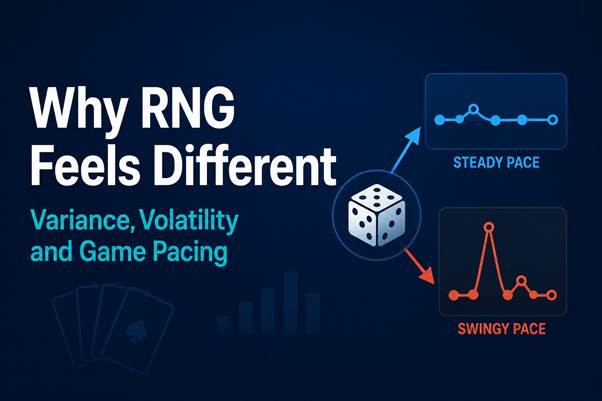
Variance is not just the reason your opening hand sometimes collapses. It is the reason that two games with similar rules can feel completely different. One design gives players small, steady changes. Another waits, stays quiet, then swings the whole session with one feature, draw, crit, or topdeck. The random number generator is the engine. Variance is the rhythm players feel.
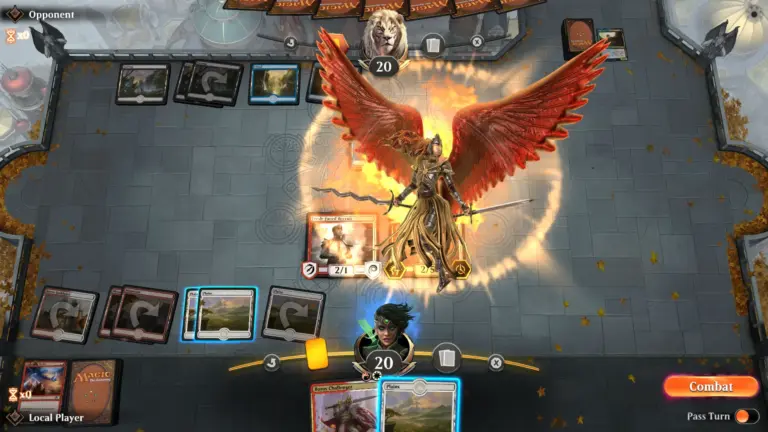
Card players understand this. A strong deck can flood, brick, or draw the wrong half, while a weaker opener curves out. Work on input-output randomness in collectible card games separates randomness that happens before a decision from randomness that happens after one, explaining why some outcomes feel readable, while others feel like the game interrupted the player’s plan.
Why Volatility Makes Similar Games Feel Different
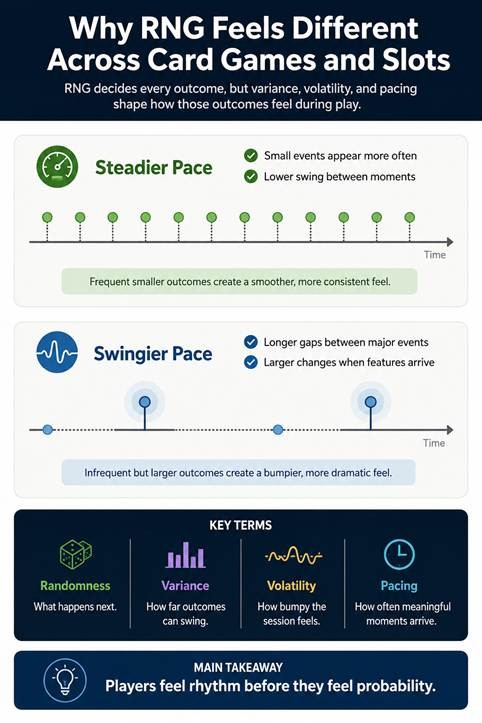
The same idea becomes clearer when digital card games are compared with gambling games, because casinos often label pacing more openly. A low-volatility slot, for instance, tends to create more frequent, smaller moments of activity, while a high-volatility slot usually spaces larger feature moments farther apart.
RTP describes the long-term percentage a title is designed around, but volatility describes how the play session may feel from one stretch to another. In that sense, the homepage of Slots LV casino is a useful reference point because the platform provides various gambling games, and often divides them according to volatility.
A player trying to understand variance can look at Slots LV casino as a direct example of how different game formats make uncertainty feel steadier, sharper, or faster. Some games also have different versions, which change the volatility. As an example, Bonus Buy titles add another layer because they shift attention from waiting for a feature to accessing that feature immediately through a fixed in-game cost.
Once that distinction is clear, the short explainer How Bonus Buy Games REALLY Work gives the concept a concrete shape. Its breakdown of Bonus Buy, RTP, and volatility is useful because it treats the feature as a pacing choice, rather than a magic button. Standard play asks the player to wait for the feature to trigger. Bonus Buy play moves attention straight to the feature itself. The ideas still depend on how often meaningful events appear and how large those events feel when they arrive.
Variance Is Not the Same as Randomness
Randomness answers a narrow question: can the exact next result be predicted? Variance asks a more useful one: how far can the experience swing before the design starts to show? Players often blend those ideas together because both involve uncertainty, but they do different work.
A card draw is random. A deck’s variance depends on factors such as land count, curve, card redundancy, mulligan rules, and match length. A deck with 4 copies of the same early play feels steadier than a deck built around many unique cards. Both can be strong, but they ask the player to tolerate different kinds of uncertainty.
That difference is why some games feel fair, even when they are hard, while others feel challenging, even when the numbers are balanced. A game with frequent small corrections lets the player keep adjusting. A game with long, quiet stretches and sudden spikes asks for patience without much feedback. Neither is automatically better. Each creates a different contract with attention.
The hardest part of variance is that players rarely experience it as math. They experience it as timing. Missing a land drop on turn 3 feels worse when the opponent curves out. Drawing 4 lands in a row feels sharper after keeping a hand with enough action. Losing to a topdeck feels more memorable than winning.
That is why short samples can distort judgment. A 7-game winning streak can feel like evidence, but it may only be noise wearing a convincing costume. Strong players still notice rough sequences. They simply avoid turning every sequence into a theory about the whole game.
The better question is whether the decision made sense before the result arrived. Keeping a hand, sequencing threats, playing around removal, or choosing when to trade should be judged against the available information. Variance can punish a correct decision and reward a wrong one. Over enough games, the pattern becomes clearer, but single moments are loud by nature. You see this exact same setup playing out in the world of poker; the decisions you make and the way you read the other players will affect how well you do at the table, but randomness and variance will still hold sway in many cases.
Reading Pace Before Reading Results
Variance becomes easier to understand when players start with pace. How often does the game create meaningful moments? How large can those moments become? How much control does the player have around them? That frame works for card games, RPG loot systems, roguelike builds, poker tournaments, and slot features because it starts with structure, rather than frustration.
A swingy game is not automatically deeper. A steadier game is not automatically shallow. Low variance rewards patient adjustment. High variance creates sharper turning points. The player’s job is to understand which experience they are choosing before the result pulls emotion into the foreground.
That is the hidden difficulty setting. It rarely appears on the screen during play. Once players can read variance, random outcomes stop looking like isolated shocks. They become part of the game’s pulse, close to the relationship between challenge, attention, and absorption described in work on flow and immersion in video games.