
Every card in MTG Arena has a hidden price tag. Not the gem or gold cost in the store, the wildcard cost. Rare and mythic wildcards are finite, slow to accumulate, and impossible to trade up from lower rarities. That scarcity turns every deck-building decision into a resource allocation problem with long-term consequences.
Understanding wildcard economics isn’t optional for competitive players. It’s the difference between building a collection that compounds over time and spinning your wheels on decks that rotate into irrelevance.
Wildcards Are a Hidden Resource Tax
Wildcards function as MTG Arena’s main crafting currency, tradeable one-for-one for any card of matching rarity. The catch is the acquisition rate.
Rare wildcards drop approximately once every 30 packs opened. The wildcard track alternates between four rare and one mythic wildcard payouts, making mythic scarcity the constraint in competitive play.
The system also explicitly prevents trading up. Common wildcards cannot become rares. Uncommons cannot become mythics. This design choice, confirmed by MTGA developers with no plans for change, means every rarity tier is its own isolated economy. Each rare wildcard spent is an opportunity cost measured against every future card you might need.
Format Commitment Changes Your Wildcard Math
Standard rotations hit approximately every three months with a new set release, and each one reshapes the metagame. Spending eight rare wildcards on a deck that becomes obsolete within weeks isn’t just inefficient, it’s a strategic error that compounds if you repeat it. Players who track rotation schedules and identify cards with multi-set staying power extract dramatically more value per wildcard spent.
The same tension appears across other digital gaming spaces. Casino players chasing large jackpots or seeking crypto casino instant withdrawal options are often drawn to immediate rewards and fast outcomes, while long-term MTG Arena players usually benefit more from patience and careful resource management. The players who treat wildcards as investments rather than impulse purchases tend to stay competitive much longer.
The next Standard rotation isn’t until January 2027, which creates an unusually stable 12-month window, a rare opportunity to invest wildcards with confidence.
When Instant Access Redefines Player Expectations
The digital collectible card game market was valued at USD 3.1 billion in 2024, according to market research on digital CCGs. Approximately 59% of players now treat in-game economies as key gameplay mechanics rather than peripheral systems.
That framing matters. When the economy is gameplay, wildcard acquisition speed becomes a competitive variable, not just a monetization detail.
MTG Arena operates on a “pay to get on even terms faster” model rather than direct pay-to-win. But as competing platforms offer greater asset fungibility and exit value, the non-tradeable wildcard structure creates friction that players increasingly notice and factor into format commitment decisions.
Prioritizing Wildcards Over Raw Win Rate
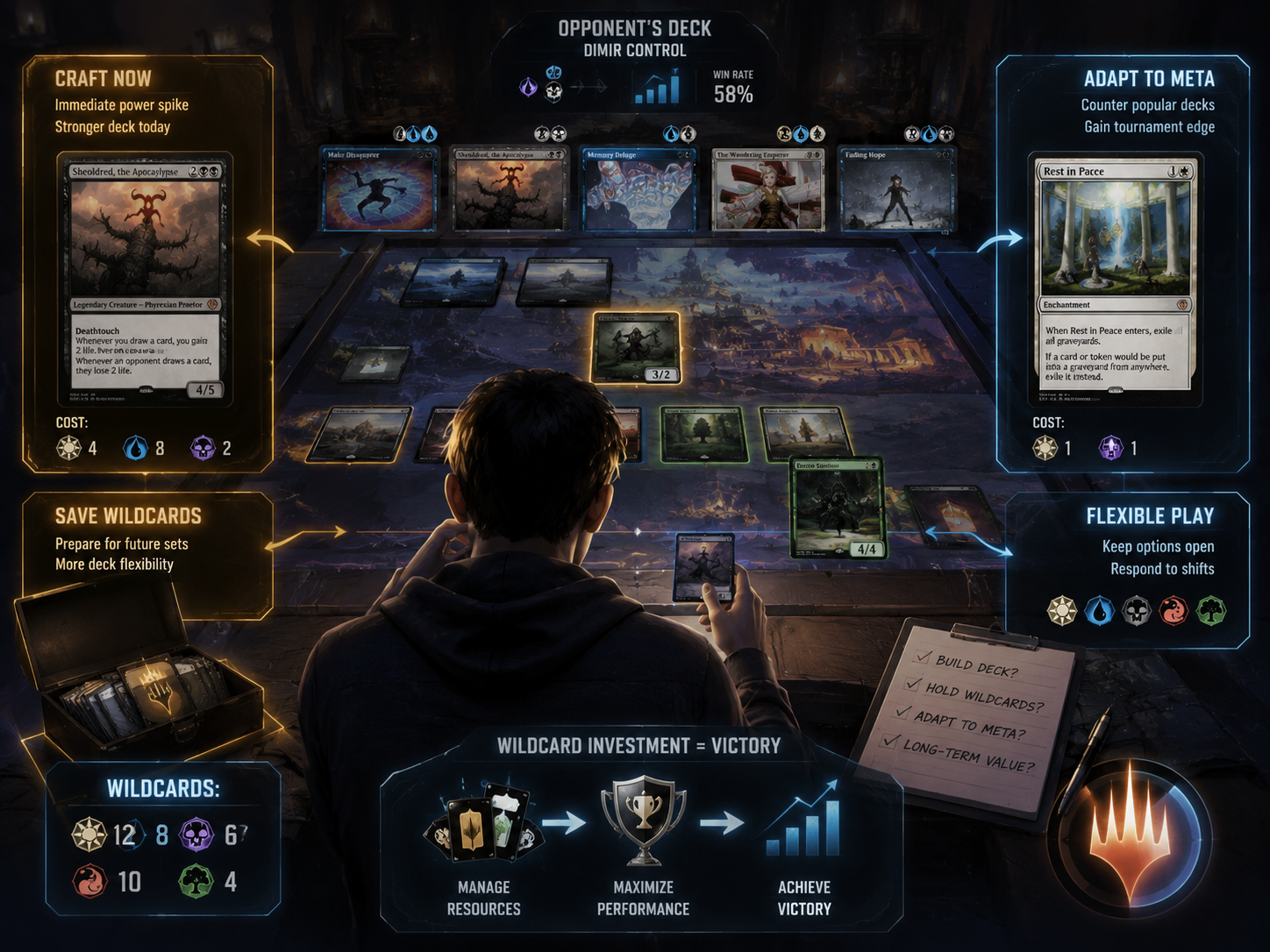
The most common wildcard mistake is chasing the current top deck without evaluating card overlap. A 58% win-rate deck built around four mythic wildcards that appear in no other archetype can easily become a bad investment.
A slightly weaker 55% win-rate deck may offer far better long-term value if its key rares fit into multiple viable strategies. Versatility multiplies wildcard value across the collection.
Ban reimbursements exist but don’t fully offset rebuilding costs, as analysis of MTG Arena’s pay structure confirms. The November 2025 “mouse package” ban left players who had crafted those cards in a net-negative position relative to free-to-play recovery timelines.
The practical takeaway is straightforward. Treat wildcards like a depleting resource with a long restock cycle, because that’s exactly what they are. Format stability, card overlap, and rotation proximity should weigh as heavily as raw power level in every crafting decision.